How Much Does a Liquor License Cost?

What Goes Into the Cost of a Liquor License
So, you’re thinking about opening a liquor store? That’s exciting, but before you can sell a single bottle, it’s important to understand how liquor licensing costs actually work.
The cost of a liquor license isn’t a single fixed number. Depending on where you open your business and what type of alcohol sales you plan to offer, the total expense can come from several different sources:
Government Fees
Government fees include application, investigation, approval, and renewal fees paid to the state and sometimes local authorities.
In some states, these fees are only a few hundred dollars, while in others they can reach several thousand depending on the license type and location.
License Availability and Market Prices
In some areas, the biggest cost isn’t the government fee itself but the price of obtaining the license from another owner. Many states limit how many licenses can exist through quota systems or population-based formulas.
When licenses are capped, new businesses may need to win one through a lottery or purchase an existing license on the open market. Because supply is limited, market demand can push prices far beyond standard government fees.
For example, Florida issues quota licenses based on county population, while New Jersey applies municipal population caps.
In these markets, two similar liquor stores can face dramatically different startup costs simply because one must purchase a scarce license while another operates in an area where licenses are more readily available.
State-Level Alcohol Regulations
Alcohol licensing in the United States is primarily handled at the state level, which means rules can change dramatically across state lines. Some states operate under control systems where government agencies manage the sale or distribution of spirits, and in certain cases even run retail liquor stores.
In these states, opening a private liquor store may follow a very different process than in traditional license states.
Local Rules and Approvals
Cities and counties may add their own approvals, zoning requirements, fees, and public hearings. For example, some jurisdictions remain “dry,” meaning alcohol sales are restricted or prohibited entirely, which can further affect availability and cost.
{{DEMO_CTA="/components"}}
License Type
Finally, the type of license itself plays a major role in pricing. Most states structure licenses around two main questions: what you can sell and where customers can consume it.
- What you’re allowed to sell: Beer-and-wine licenses are typically cheaper and easier to obtain, while full liquor (spirits) licenses often carry higher fees and stricter requirements.
- Where alcohol is consumed: Off-premise licenses (liquor stores, bottle shops, grocery stores) are usually regulated differently from on-premise licenses (bars and restaurants), leading to different pricing structures and approval processes.
State-by-State Liquor License Costs
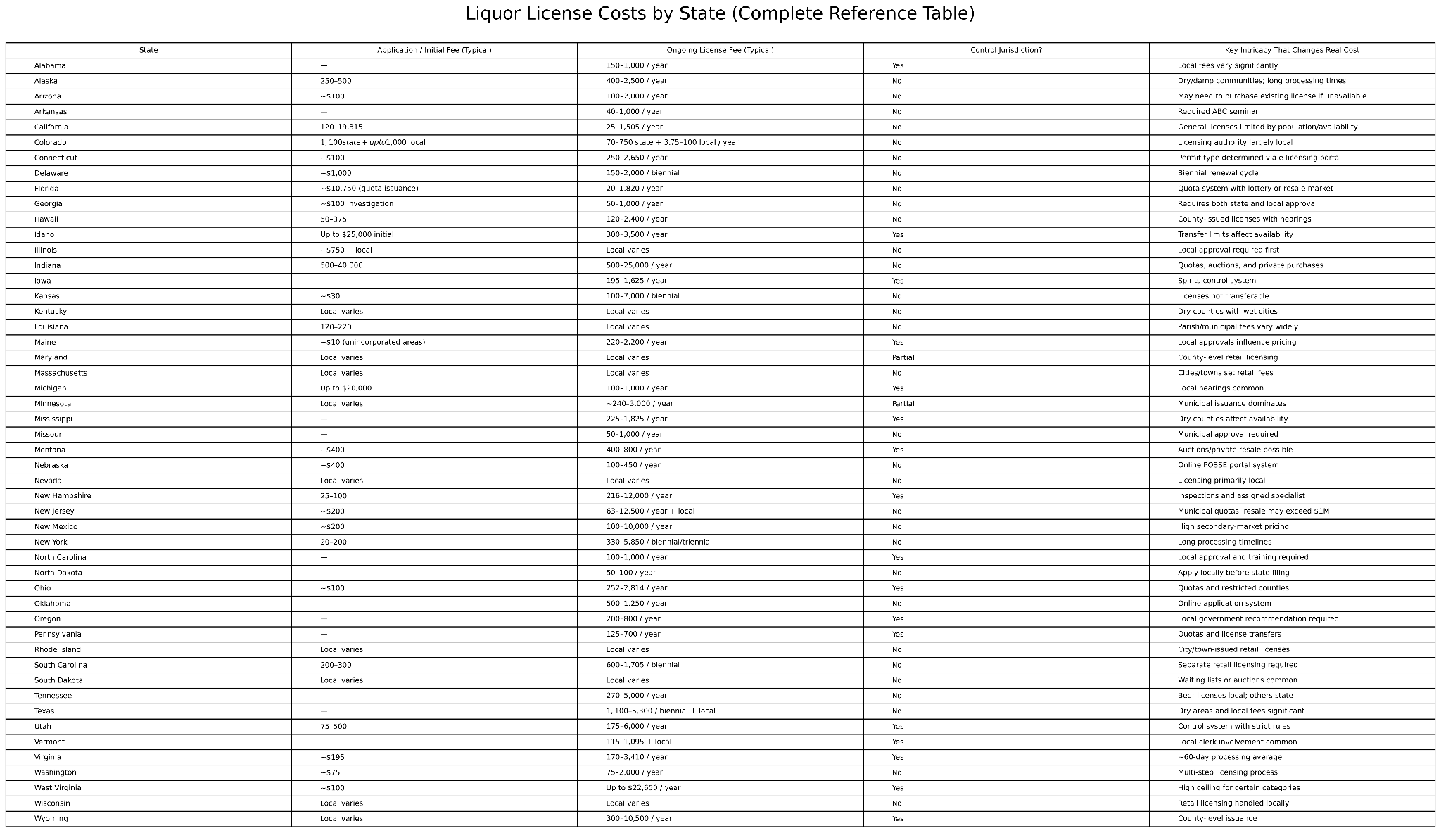
Below is a table with state-by-state starting points:
- Application/initial fee shows typical state-level application or issuing fees (where clearly stated).
- Ongoing license fee shows the typical range of state-level annual/biennial/triennial fees described.
- Control jurisdiction flags whether the state is listed among control jurisdictions by National Alcohol Beverage Control Association (noting that “control” can be wholesale-only or include retail control depending on the jurisdiction).
- Key intricacy highlights the “gotcha” most likely to change what you pay (local fees, quotas, auctions, transfer limits, etc.).
Once Your License Is Approved, You Still Need the Right POS System to Run the Store
Now that you understand how liquor license costs work and what to expect during the approval process, the next step is preparing your store to actually operate day to day.
This is where choosing the right POS system becomes one of the most important decisions you’ll make.
Unlike general-purpose POS systems, liquor stores face unique operational challenges. You’re dealing with cases and single bottles of the same product, vintage variations, bottle deposits, distributor invoices, delivery logistics, and strict compliance requirements.
A standard POS requires complex workarounds to handle these realities, which weighs you down as your business grows.
Santé POS was built specifically for liquor and wine retailers, bringing all the tools you need into one platform designed around how liquor stores actually operate.
Here are just some of the features of Santé POS:
- AI invoice scanning: Upload a distributor invoice or snap a photo, and Santé automatically converts it into inventory entries. This reduces receiving mistakes and eliminates hours of manual data entry.
- Multi-channel synchronization: Santé’s all-in-one platform ensures in-store, ecommerce, and delivery sales stay synchronized, ensuring every update accurately corresponds to one single source of truth in one inventory.
- Spot check mobile counting: Walk the aisles with your phone, scan products, and correct counts instantly. These counts are tied to employee logins so managers can review changes before approving inventory updates.
- Smarter replenishment: Set minimum stock levels and let the system flag low items, helping you reorder fast movers on time while avoiding overstocking slow sellers.
- Liquor-specific tracking: Sante’s has built-in support for bottle deposits, kegs, and a structured product catalog designed specifically for alcohol retail.
- Compliance-ready reporting: Detailed sales and inventory reporting helps simplify audits, tax preparation, and regulatory reporting requirements common in alcohol retail.
Schedule a demo to see how Santé POS can simplify daily operations and help your liquor store run smoothly from the moment you open your doors.
FAQ
Do I need a surety bond to get a liquor license, and how much does it cost?
In most states, yes. A surety bond guarantees that you'll pay any alcohol taxes, fines, or fees you owe, and it's a separate cost from your government licensing fees since you're paying a private surety company, not the state.
Required bond amounts typically range from $2,500 to $7,500, though the amount is set by your state agency, and you only pay a percentage of that amount as your actual premium, usually between 1% and 5%.
So a $7,500 bond might only cost you $75-$375 out of pocket per year, not the full bond amount. Some states set it much lower or higher: Florida requires a flat $1,000 bond for most license types, while other states base the amount on your projected tax liability.
If I buy an existing license from another owner, are there fees beyond the purchase price?
Usually, yes. The market price you pay the seller is separate from the transfer or reissuance fee your state charges to process the change of ownership. It's typically much smaller than the purchase price itself, but it's an extra line item worth budgeting for rather than assuming the market price is the full cost.
How long does it take to get a liquor license approved?
It varies enormously by state and license type. A standard application can take 90 to 180 days from start to finish in a mid-sized city, but that's for a straightforward, non-quota license. If you're buying an existing license in a quota state, the transfer itself has to be approved by the state alcohol board, which can add another 3 to 12 months on top of finding a seller and negotiating a deal.
Can I get a loan specifically to cover a liquor license?
It's more complicated than financing other startup costs. SBA loans generally will not finance a liquor license as a standalone asset, because licenses are treated as non-transferable personal property in most states and can't be seized and resold if a borrower defaults. However, an SBA 7(a) loan can finance a full business acquisition where the license cost is baked into the purchase price. For standalone license purchases in quota states, seller financing is typically the realistic path, with buyers putting down 20-30% and the seller holding the balance as a note for a few years at market interest rates.
Is my application fee refundable if I'm denied?
In most cases, no. Application and investigation fees generally cover the cost of processing your application and running background checks regardless of the outcome, so they're typically non-refundable even if you're turned down. Confirm this directly with your state or local board before applying, since policies do vary.
Are control states cheaper or more expensive than license states?
It depends on what you're trying to do. In control states, the government manages some or all of the wholesale (and sometimes retail) alcohol business directly, which can mean private retail licenses are either unavailable or handled through a completely different process than in open states.
This isn't necessarily cheaper or more expensive across the board, it's a structurally different system, so the real question is whether private liquor stores can even operate in your specific control state before cost becomes the deciding factor.
What's the cheapest state to get a liquor license in, and what's the most expensive?
On the low end, states like Idaho issue basic beer-and-wine licenses for as little as $50-$100 in state fees.
On the high end, quota states like New Mexico and Florida can push effective license costs into the hundreds of thousands or more, since you're not just paying a government fee, you're often buying a scarce license on the open market.
The gap between the cheapest and most expensive state isn't small, it's closer to a 1,000x difference in extreme cases.
Are liquor license costs tax deductible?
Generally, yes, in some form, but the details depend on your business structure and how the cost was incurred.
Annual renewal fees are typically treated as an ordinary deductible business expense, while the purchase price of a license bought on the open market is often capitalized and amortized as an intangible asset over time rather than deducted all at once.
This is worth confirming with an accountant familiar with alcohol retail, since the treatment can vary and this isn't tax advice.
Your submission has been received!