10 Items to Sell in a Liquor Store to Boost Revenue
The bottles on your shelves aren't carrying growth the way they used to. U.S. spirits supplier revenue fell 2.2% in 2025, according to the Distilled Spirits Council, and NIQ found that dollar sales slipped across beer, wine, and spirits over the same year.
That doesn't mean customers stopped spending. Instead, they're shifting toward different products, buying more convenience and add-ons, and picking up items they used to get somewhere else. The stores that grow are the ones that adjust their mix to match.
Below are ten items worth making room for, with what each one does for your store, how to sell it, and what to watch out for. We'll also cover a few products that need a separate license, and how to tell whether a new item is earning its spot.
How to Decide What to Add to Your Shelves
Every product in your store should be doing a job. Most new items fall into one of three:
- Driving traffic: Products people make a trip for, like a hard-to-find bottle or the RTD everyone's talking about.
- Building the basket: Add-ons that ride along with a planned purchase, like mixers, ice, or a gift bag.
- Protecting margin: Items that sell at a higher markup than the bottles around them, like accessories and gift sets.
Before you add anything, check three things.
First, make sure your license covers it, since what you can sell depends on your license type. If you only hold a beer-and-wine permit, the rules on what a license to sell beer actually covers will limit which of the items below you can stock.
Second, start small, with a few SKUs and a single shelf or cooler door, rather than a full category reset.
Third, set a date to review the numbers so a test doesn't turn into permanent dead stock.
For ideas on what to test, ask your cashiers to keep a running list of products customers ask for that you don't carry. A request that keeps coming up is a better signal than any trend report.
10 Items to Sell in Your Liquor Store
1. Ready-To-Drink cocktails
RTDs are the strongest growth story in the industry right now. Spirits-based cocktails brought in $3.8 billion in 2025, up 16.4%, while overall spirits revenue fell, according to the Distilled Spirits Council.
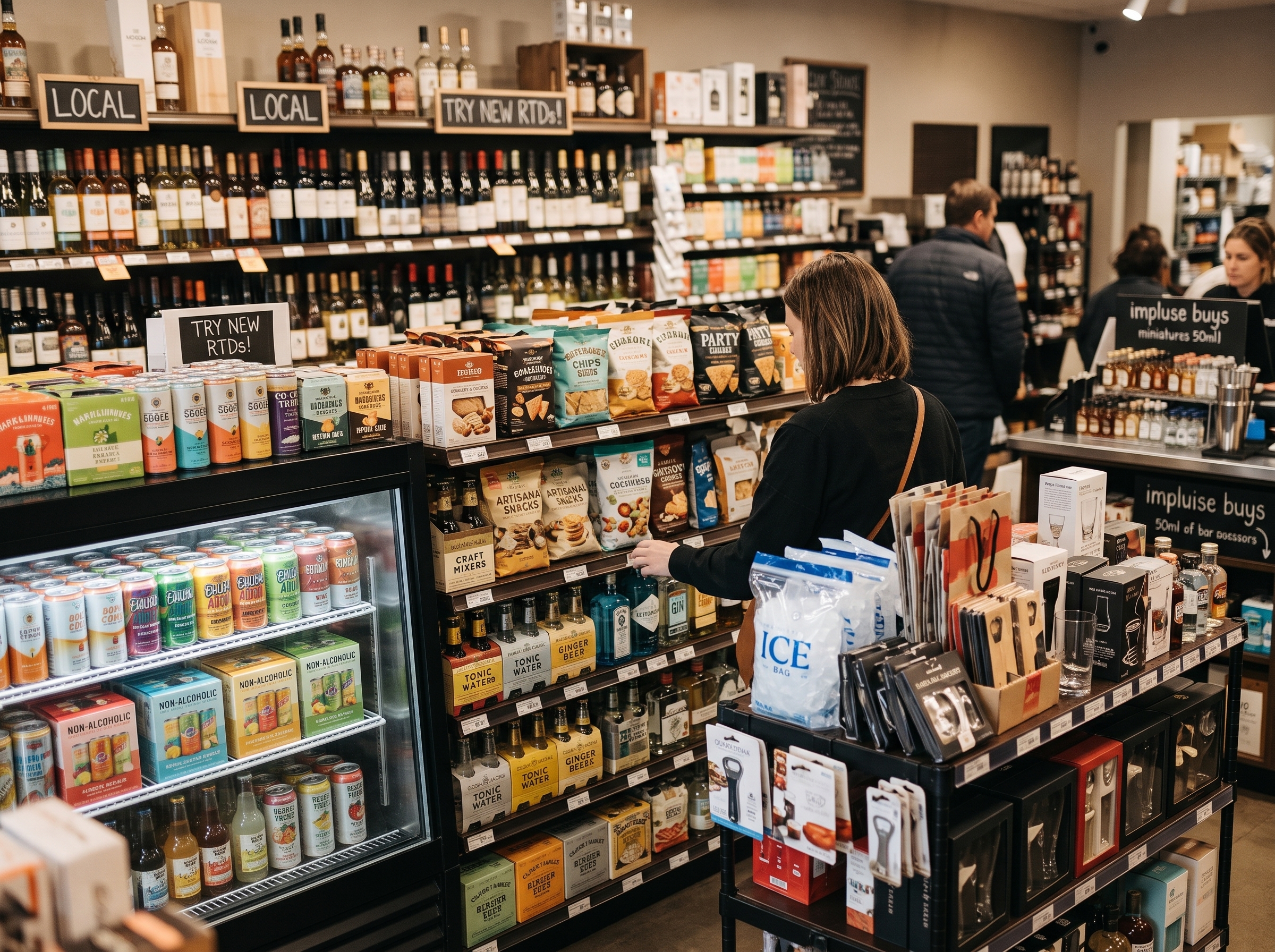
How to sell them: Keep them cold and close to the front, and stock both single cans and 4-packs so customers can try a flavor before committing. Rotate seasonal flavors every few months to give regulars something new to pick up.
Watch out for: RTDs made with spirits are regulated differently from malt-based seltzers, so check that your license covers the ones you stock.
2. Non-alcoholic and low-ABV drinks
Non-alcoholic beer, wine, and spirits have passed $1 billion in sales, according to NIQ. Customers who are cutting back still want something to bring to a party, and the drinkers in their group will often shop in the same aisle.
How to sell them: Give them a dedicated, clearly signed section rather than scattering them through the store. Train staff to suggest a non-alcoholic option when someone is buying for a group. It's one of several alcohol trends liquor stores can act on now, and one of the easiest to test with a small shelf.
Watch out for: Non-alcoholic beer usually has a shorter shelf life than regular beer, so order in smaller quantities and check dates when you rotate stock. Products under 0.5% ABV generally aren't regulated as alcohol, but some states and local governments still set rules on how they're sold, so confirm yours and decide whether your staff should check IDs for them anyway.
3. Local craft beer, wine, and spirits
Local products are one of the few things a grocery chain can't easily copy. A shelf of bottles from breweries, wineries, and distilleries within driving distance gives people a reason to choose your store, and locals tend to be loyal to them.
How to sell them: Tell the story on a shelf tag: who makes it and where. Invite producers in to pour, since in-store events and tastings are one of the best ways to introduce a product nobody has heard of yet.
Watch out for: Local doesn't mean direct. Unless your state allows the producer to self-distribute, you'll still need to buy through a licensed distributor.
4. Premium and allocated bottles
High-end and super-premium spirits made up 58% of U.S. spirits revenue in 2025, according to the Distilled Spirits Council. NIQ also notes that premium buying is increasingly happening through smaller bottle sizes, as shoppers trade up without spending as much on a single purchase.
How to sell them: Stock 375ml and 200ml versions of premium brands next to the full-size bottles, so curious customers have a lower-priced way to try them. For allocated bottles, use a waitlist or reward your most loyal customers first. A rare bottle that brings a regular back is worth more than one that sells to a stranger in five minutes.
Watch out for: Expensive bottles tie up cash and are a favorite target for theft, so keep the high-value ones behind the counter or in a locked case. If you hand out allocated bottles through a raffle, skip any version that requires a purchase to enter, since some states treat that as an illegal lottery.
5. Chilled singles and grab-and-go
A lot of liquor store trips are quick ones: something cold on the way home, or one more drink for tonight. Single cans, bottles, and small formats in the cooler serve those trips and add sales that a case-only shelf misses.
How to sell them: Break cases into singles and keep the cooler full and organized, with the fastest sellers at eye level. Put the singles cooler near the register for last-minute pickups. Miniatures belong here too. A rack of 50ml bottles of flavored vodka, whiskey, and liqueurs by the counter is cheap enough to grab without thinking, and it gives customers a low-risk way to try a new brand.
Watch out for: Some licenses come with conditions that limit or ban single-can sales, especially in areas with past problems. California, for example, sometimes adds this restriction when issuing a license, so check yours before you stock singles. Some cities and states also restrict or ban the sale of 50ml bottles, so confirm the local rules before you add minis.
6. Mixers, bitters, syrups, and garnishes
Someone buying a bottle of gin for a party usually needs tonic, limes, and maybe a bag of ice. If they have to stop at a grocery store for the rest, that's money leaving your store.
How to sell them: Shelve mixers next to the spirits they go with, not in a separate aisle. Put tonic beside gin, ginger beer beside vodka, and margarita mix beside tequila. Pre-built cocktail kits with a recipe card on top make an easy gift and a bigger basket.
Watch out for: Fresh garnishes like limes and mint spoil quickly, and niche syrups can sit for months. Start with shelf-stable basics and a few popular flavors before branching out.
7. Ice and party supplies
Ice is a classic impulse buy, and it brings people in on the busiest days of the year. Cups, coolers, and other party basics ride along with the same trips.
How to sell them: Keep the ice freezer stocked and visible, especially before holiday weekends and big games. If you sell kegs, offer cups, pumps, and ice alongside them, and make sure your keg deposits are tracked so returns don't turn into a headache.
Watch out for: Some states and cities require stores to register kegs and record the buyer's information at the time of sale. Check your local rules before you start selling kegs, and don't let low-margin party basics crowd out better-selling products in prime spots.
8. Snacks, cheese, and charcuterie
Food turns a bottle into an occasion. Chips and nuts next to the beer cooler, or cheese and crackers next to the wine, give customers an easy reason to spend a few more dollars.
How to sell them: Build small pairing displays, like a red wine with a hard cheese and crackers, or a craft beer with pretzels. Pairing food with wine is also one of the easiest wine marketing strategies to drive more sales, since it helps customers pick a bottle for a specific meal.
Watch out for: Prepackaged snacks are usually simple to add. Cheese, charcuterie, or anything perishable or unpackaged may need a local health permit and proper refrigeration, so check with your city or county first.
9. Gift sets, gift bags, and gift cards
Gifting peaks from Thanksgiving through New Year's, but birthdays, weddings, housewarmings, and corporate gifts keep it going all year. A customer buying a gift is usually less price-sensitive and more open to a suggestion.
How to sell them: Stock branded gift sets and offer gift bags or wrapping at the register. Put together a few ready-made gift bundles at different price points. Gift cards, especially digital ones you can sell online, are a simple add-on for customers who don't know what to pick.
Watch out for: Holiday gift sets that don't sell by January can be hard to move the rest of the year, so order conservatively and reorder if they sell through. Gift cards also come with state rules on expiration dates and unused balances, so check yours before you set terms.
10. Barware, glassware, and accessories
Bottle openers, corkscrews, wine stoppers, cocktail shakers, and glassware all sit naturally next to what you already sell. They tend to carry a higher markup than the bottles beside them, and they make easy add-on gifts.
How to sell them: Keep a small selection by the register and a fuller display near the wine and spirits. Bundle a nice bottle with two glasses or a shaker for a ready-made gift.
Watch out for: Glassware breaks, and slow-moving accessories can sit on a shelf for a long time, so start with a small selection of proven basics. If a distributor offers branded glassware or displays for free, check your state's tied-house rules first, since suppliers are often limited in what they can give retailers.
Products That Need a Separate License or Extra Care
Some of the most profitable add-ons in a liquor store come with their own rules. Adding one means another license to renew and another set of records to keep, so treat it as part of your liquor store compliance routine, not a one-time setup.
Lottery tickets
Lottery brings in regular, repeat customers, and the store earns a commission on every ticket. In Texas, for example, retailers receive 5% of lottery sales. Commission rates and application rules vary by state, and you'll need to be approved as a retailer by your state lottery before you can sell.
Tobacco and cigars
Cigars in particular pair well with whiskey and make a natural gift. Most states require a separate tobacco retail license, and the federal minimum age to buy tobacco is 21. Your ID checks need to cover tobacco just as strictly as alcohol, since both are subject to compliance checks.
Keeping a liquor store inspection checklist up to date makes it easier to stay ready for every license you hold.
Hemp-derived THC drinks
Until recently, THC beverages were one of the fastest-growing new categories in liquor stores. That's about to change. A new federal law treats hemp products with more than 0.4 milligrams of total THC per container as marijuana, which effectively bans most THC drinks.
Congress could still change the rules, so check the current federal and state law before you order or reorder any THC products. If you already stock them, plan how you'll sell through or return your inventory before the deadline.
How to Make New Products Sell
A new product won't sell itself if it's hidden on a bottom shelf. A few habits make the difference:
- Use the counter for small add-ons: The checkout counter is where customers have already decided to buy, so a low-priced extra is an easy yes. Keep it for small, quick items like minis, bottle openers, snacks, and gift cards, and rotate them so regulars notice something new.
- Put it next to what it goes with: Mixers beside spirits, snacks beside beer, glassware beside wine. Customers buy add-ons when they can see them at the moment they're choosing the main item.
- Use your endcaps: Endcaps are the first thing many customers see in an aisle, which makes them the best spot to introduce something new.
- Bundle it: A spirit, mixer, and garnish sold together at a small discount gives customers a reason to try all three.
- Tell people about it: Shelf tags, a staff recommendation at the register, and a mention in your next email or social post all help a new item get noticed.
- List it online: If you sell online, add new products to your website at the same time they hit the shelf.
Timing matters as much as placement. The same product can sit for months, then sell out in a week when the season is right, so plan your add-ons around the calendar:
How to Tell If a New Item Is Working
Give every new product a fair test, usually 60 to 90 days, then look at the numbers instead of your gut feeling. Track:
- Sell-through: How much of what you ordered actually sold.
- Margin dollars: How much profit it brought in, not just its margin percentage.
- Attach rate: How often it sells alongside another item. A mixer that shows up in a third of gin purchases is doing its job, even if it never sells on its own.
The numbers are only as good as your stock counts. If your system says you have twelve bottles and the shelf has eight, your sell-through is wrong too. A regular routine for counting inventory at your liquor store keeps your data honest.
If an item isn't moving after a fair test, try a better location or a bundle once. If it still doesn't sell, cut it and use the space for something that does.
How Santé Helps You Find and Sell Your Best Products
Choosing what to stock is easier when your sales data is clear, and selling it is smoother when your POS can handle the way liquor stores actually sell. Santé is a POS and ecommerce platform built specifically for liquor and wine stores.
- See what's working: The sales dashboard and Smart Ordering show which products are trending and which are sitting, so you know what to reorder and what to cut.
- Sell singles and packs from the same stock: Case and pack breakdowns let you sell beer and RTDs by the can, the pack, or the case without manual adjustments.
- Run bundles automatically: Mix-and-match promotions and case discounts apply at checkout, in the store and online, so a spirit-and-mixer deal works without cashiers doing the math.
- Handle the extras: Sell physical and digital gift cards, track lottery sales and payouts by register and by employee, and apply bottle and keg deposits automatically based on your state's rules.
- Sell it online, too: Santé's product catalog fills in images and descriptions for the bottles you carry, so new products can go live on your website as soon as they're on the shelf.
Book a free demo to see how Santé can help you decide what to stock and sell more of it.
FAQ
What sells best in a liquor store?
It depends on your location and customers, but ready-to-drink cocktails are the strongest growth category right now, and core beer, wine, and spirits brands still make up most sales. Your own POS data is the best guide to what sells in your store.
Which liquor store products have the highest margins?
Add-ons like barware, accessories, mixers, and gift items usually carry a higher markup than the bottles themselves. Bottles often face price competition from nearby stores and, in some states, minimum pricing rules, which leaves less room to raise prices.
Can liquor stores sell food?
In most states, yes. Prepackaged snacks are usually simple to add. Perishable or unpackaged food, like cheese and charcuterie, may require a local health permit and the right refrigeration.
Do I need a license to sell lottery tickets or tobacco?
Yes. Lottery sales require approval from your state lottery, and most states require a separate tobacco retail license. Both come with their own record-keeping and age-check rules.
Can liquor stores still sell THC drinks?
Not after December 11, 2026, unless Congress changes the law first. The new federal rules treat hemp products with more than 0.4 milligrams of total THC per container as marijuana, which covers most THC beverages. Check federal and state law before stocking them.
How many new products should I add at once?
Start with a few at a time, ideally in one category, so you can tell what's working. Adding a dozen new items at once makes it hard to know which ones drove the change in your sales.
What should a new liquor store stock first?
Start with the core brands your neighborhood expects in beer, wine, and spirits, then add a cooler of chilled singles and RTDs, mixers, and ice. Once you have a few months of sales data, use it to decide which of the other items on this list are worth the space.
Your submission has been received!